Across the river: the Aventine keyhole at opening time
One green door on a quiet square, one small hole, and at the far end of a hedged avenue the dome of St Peter's. Go before the queue forms, then walk on to the Orange Garden.
Early in the morning there is usually no one at the door; by mid-morning and at weekends the line can stretch along the square.
 07:30
This walk takes you off the Vatican side of the river for a morning, and the reason is a view of the Vatican you cannot get from anywhere closer. On top of the Aventine, the southernmost of Rome's seven hills, there is a gate with a keyhole, and through the keyhole you see the dome of St Peter's, small, distant and perfectly framed. It is one of the oddest sights in the city, and early in the morning you may have it to yourself.
The Aventine is a residential hill of villas, convents and gardens, quiet even at midday. Allow an hour and a half for the walk below, and start by half past seven. The square and the garden are public, but church and garden opening times change with the season, so check them before you go.
The climb up from the river
There are two good ways up. From the Vatican side, take a bus or taxi to the southern edge of Trastevere and cross Ponte Sublicio; on the far bank, a short way north along the Lungotevere Aventino, a walled pedestrian lane called Clivo di Rocca Savella climbs steeply between old brick walls straight up to the Orange Garden. It is the more pleasant route.
Alternatively, take metro line B to Circo Massimo, walk along the edge of the Circus Maximus and climb Via di Valle Murcia, past the city rose garden, which opens only in its flowering season in late spring. Either way, the top of the hill is a few minutes' walk from the square you want.
The square of the Knights of Malta
Follow Via di Santa Sabina south along the crest until the street ends in a small, formal square. This is Piazza dei Cavalieri di Malta, laid out in the 1760s by Giovanni Battista Piranesi, better known for his etchings of Roman ruins. It was his only built work of architecture, and you can tell an etcher designed it: the walls are covered in carved obelisks, trophies, ships and swords, more like a page of ornament than a piece of town planning.
On one side is a large green door, the entrance to the priory of the Knights of Malta, the old order of knights that still keeps its Roman headquarters here. The door is shut. In the middle of it, at the height of an ordinary lock, is a keyhole.
Looking through the keyhole
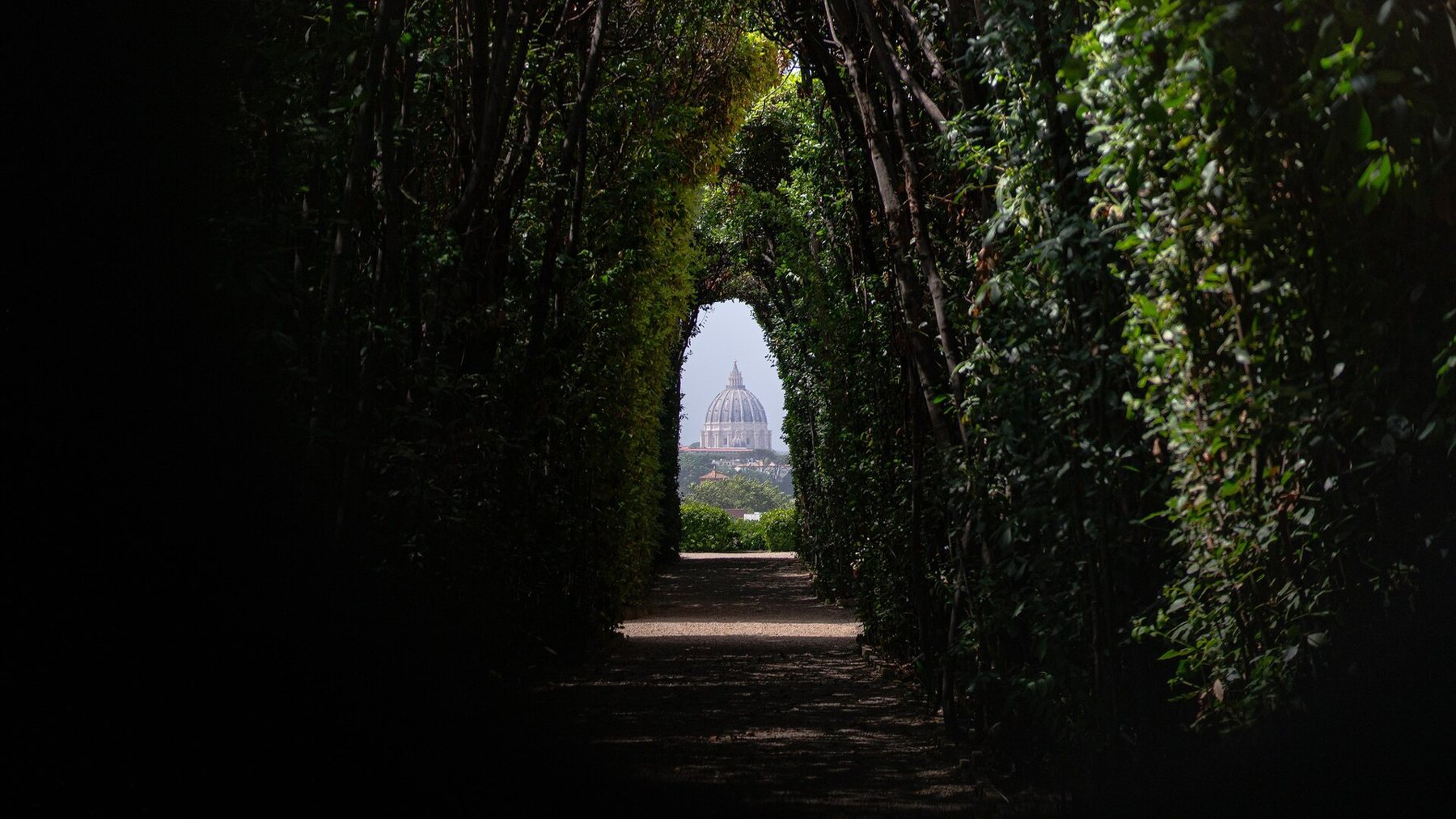
Bend down and put your eye to it. For a second you see only dark. Then it resolves: a long avenue of clipped hedges meeting overhead to form a green tunnel, a patch of garden at the far end, and, beyond and below, floating above the rooftops of Trastevere and the Vatican, the dome of St Peter's.
18:30Another hourUp the Gianicolo for the last lightNobody is quite sure whether the effect was planned. The hedges line up with the dome so neatly that it is hard to believe it was an accident, and Piranesi had an eye for exactly this kind of theatre. Whatever its origin, the view is the same as it has been for generations, and the dome is roughly three kilometres away as the crow flies.
Photographing it is harder than looking. A phone pressed close to the hole usually works better than a large camera; let it focus on the dome, not the hedge. If someone is waiting behind you, take your look and step aside; there is a rhythm to the queue later in the day, and the early morning is your reward for skipping it.
The Orange Garden
Walk back north along Via di Santa Sabina and turn into the Giardino degli Aranci, the Orange Garden, properly called Parco Savello. It is a walled park on the site of a medieval fortress of the Savelli family, planted with bitter orange trees and umbrella pines, with gravel paths and stone benches.
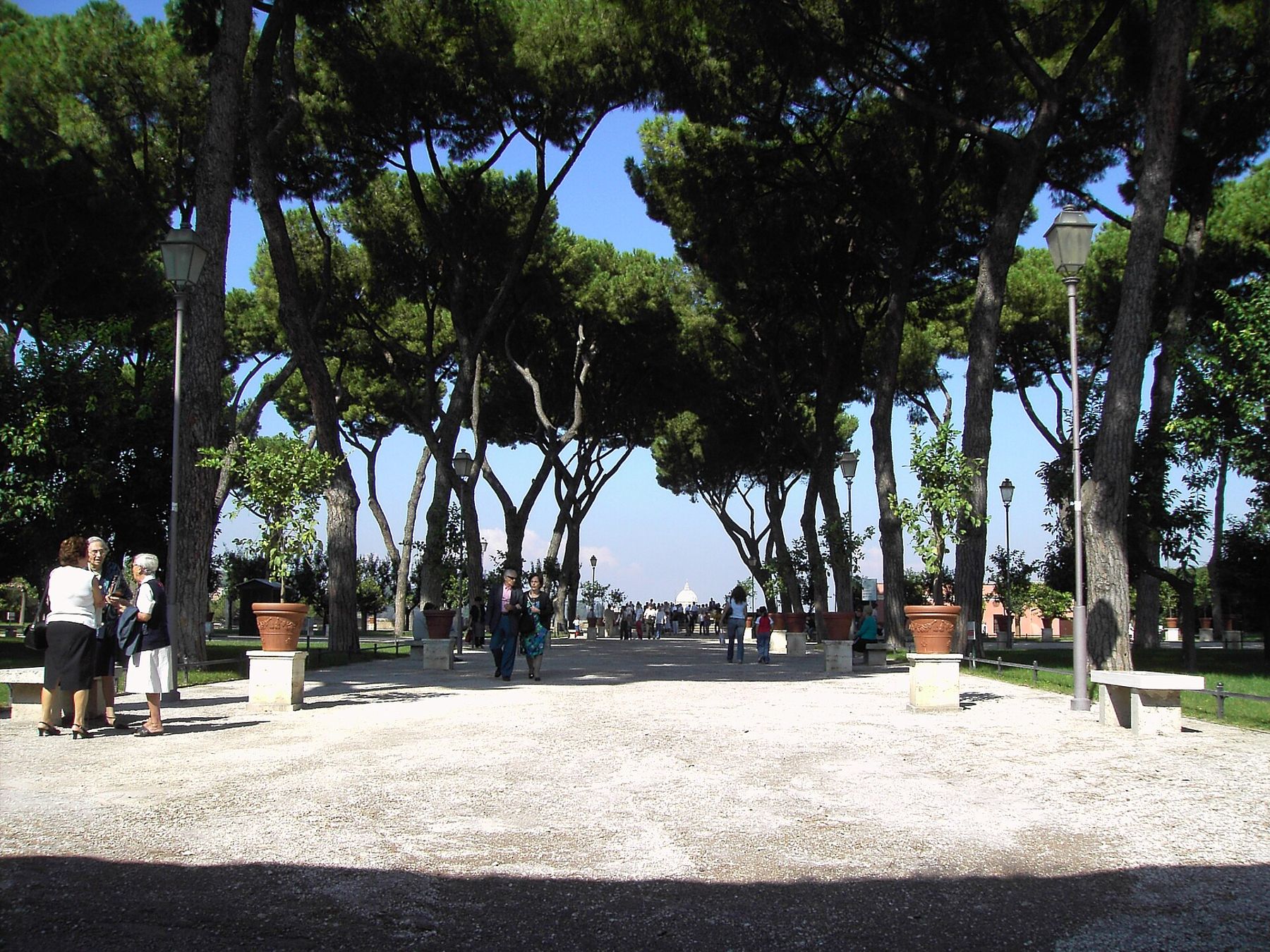
Walk straight down the central avenue to the terrace at the end. The garden stands on a cliff above the Tiber, and from the balustrade the river curves below you, the roofs of Trastevere spread across the far bank, and the long green ridge of the Gianicolo closes the view. On the right, St Peter's again, this time in full. In the morning the sun is behind you and the whole western side of the city is lit.
In the morning the sun is behind you and the whole western side of the city is lit.
Santa Sabina, bare and early
Next to the garden is Santa Sabina, one of the oldest basilicas in Rome, built in the fifth century and stripped back in the twentieth to something close to its first appearance. Inside, two rows of fluted Corinthian columns carry plain arches down a broad, bright nave. There is very little decoration; the light comes in through large windows, and it is the light, more than anything, that you remember.
Do not miss the doors. The main entrance from the portico has wooden doors from the fifth century, carved in panels with scenes from the Bible. One small panel near the top is among the earliest known images of the Crucifixion. The church belongs to the Dominicans, who have their headquarters next door, and is often open early for Mass; if a service is under way, stay at the back and come in quietly.
Just up the street is Sant'Alessio, another old church with a cloistered courtyard, worth a look if its gate is open.
Back towards the river
By nine the first groups will be arriving at the keyhole, and the hill will settle into its daytime quiet. Walk back down Clivo di Rocca Savella to the river, or drop down the other side to the Circus Maximus and the Bocca della Verità.
If you want to keep the morning by the water, cross back over the Tiber into Trastevere and work north to the gold apse of Santa Maria, open for most of the morning. And if the keyhole has made you want to see the dome up close, the obvious next step is the climb up St Peter's dome itself, where you can look back towards the Aventine from the top.
The photographs on this walk are credited by name and licence in I fotografi. The other walks are on the list of hours.
Later the same day
- Up the dome of St Peter's, step by step
- The Museums, in an order that keeps you sane
- Under the floor: the grottoes and the necropolis
- Mercato Trionfale, the market by the Vatican wall
- Standing under the Sistine ceiling
- Prati at lunchtime: wide streets, cool churches
- The Borgo and the wall the popes ran along
- Castel Sant'Angelo, from tomb to terrace
- Down the Lungara into Trastevere for the mosaics