Prati at lunchtime: wide streets, cool churches
When the Museums let you out at midday, cross Viale Vaticano into a quarter built for clerks and judges: straight shady streets, a long lunch hour and churches where the air stays cool.
No tickets and no real queues; the only crowds are office workers at lunch counters between one and half past two.
 12:30
Prati is the part of Rome that looks least like Rome. After the Museums, with their crowds and their gilded ceilings, you walk out into a quarter of tall apartment blocks, ruler-straight streets and pavement trees, built in the decades after 1870 when Rome became the capital of a united Italy and needed somewhere to house its new ministries, courts and civil servants. The name means meadows: before the grid arrived, this was open ground between the Vatican walls and the Tiber.
At half past twelve it is also the best place on this side of the river to eat. The people at the counters here work nearby and expect to be fed well and quickly, and the streets are wide enough that you never feel herded. This walk takes about an hour and a half with lunch, longer if you sit down.
Out of the walls into the grid
Start in Piazza del Risorgimento, the busy square where the Vatican wall turns a corner and trams and buses gather. It is not beautiful, but it is the hinge between two worlds: on one side the fortified wall of a sovereign state, on the other a street plan laid out by a kingdom that had just taken Rome from the popes. Look at the street names as you leave. Prati is full of the heroes of the ancient Roman Republic, the Gracchi, the Scipios, Cicero, Cola di Rienzo, a choice that was not lost on anyone at the time.
There is a well-worn story that the streets were deliberately angled so that none of them looks straight at the dome of St Peter's. Walk a few blocks and judge for yourself; the dome does tend to vanish behind rooftops just when you expect it. Whether by design or by accident, the effect is a district that turns its back politely on its neighbour.
Along Via Cola di Rienzo
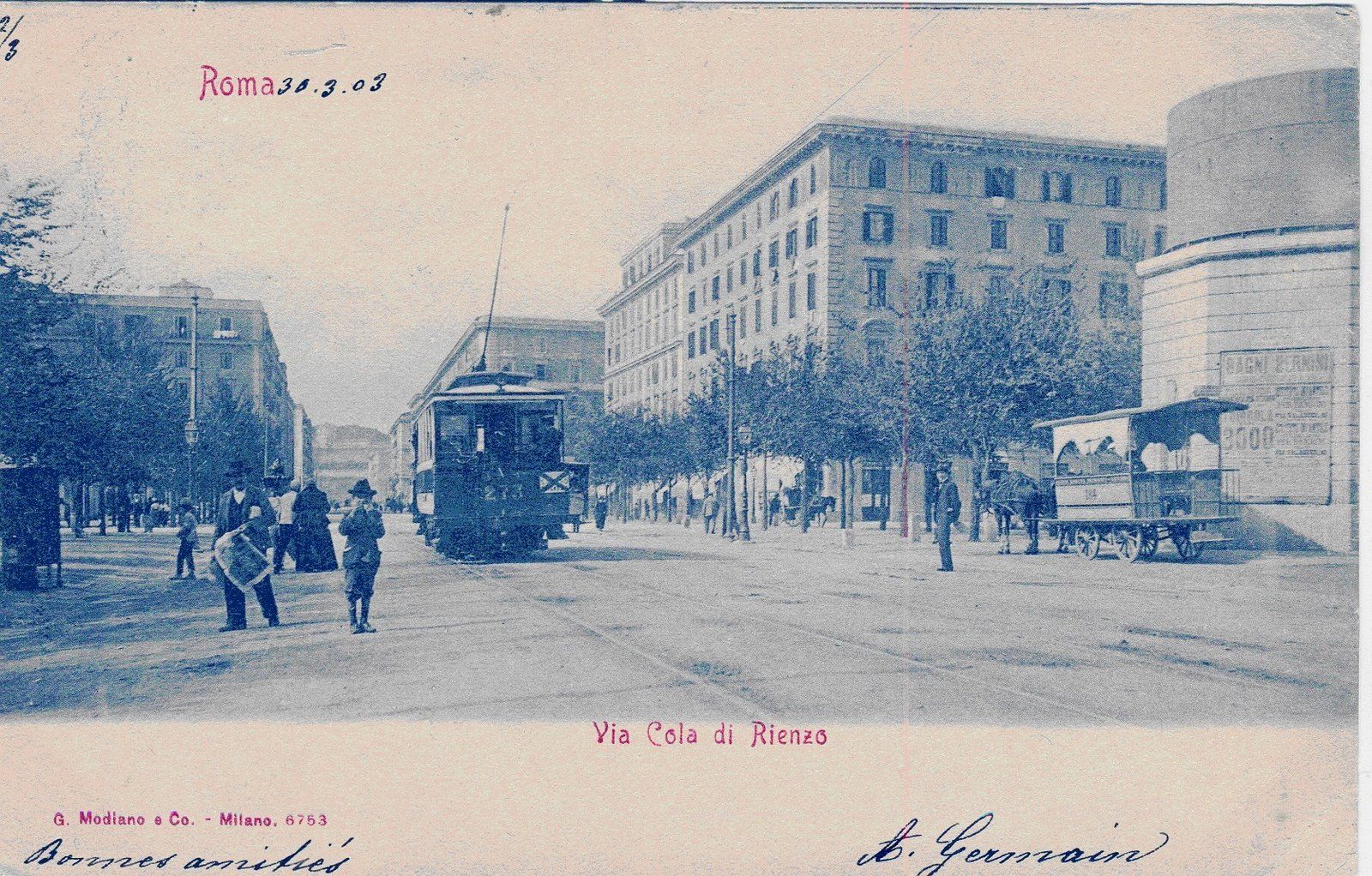
Via Cola di Rienzo is the spine of the quarter, running east from Piazza del Risorgimento towards the river. It is a shopping street of the ordinary, useful kind: shoes, household goods, pharmacies, food. The old postcard above shows it with a single tram and a horse-drawn cart; today it carries buses and a steady stream of scooters, but the proportions have not changed, and the trees still meet overhead in summer.
This is where lunch happens. You do not need a name to eat well here; you need to know what to look for. A bakery selling pizza by weight, cut with scissors and folded into paper, is the quickest lunch in Rome. Look for pizza bianca, plain with salt and oil, or topped with potato or courgette flowers in season. Fried rice balls, supplì, come warm from the counter. A bar with a glass case of tramezzini, soft white-bread sandwiches, is the other office-worker standby. If you want to sit, the side streets running off Cola di Rienzo have trattorias with paper tablecloths and a short handwritten menu; the shorter the menu, the better your chances.
Romans eat lunch between about one and half past two, and the busiest counters are busiest then. Arrive at half past twelve and you get ahead of the rush; arrive at three and some kitchens will be closing.
Two quiet churches
Prati was built quickly and its churches are young by Roman standards, which is part of their appeal. Nobody comes to see them, so you can sit in the cool for ten minutes without stepping round a tour group.
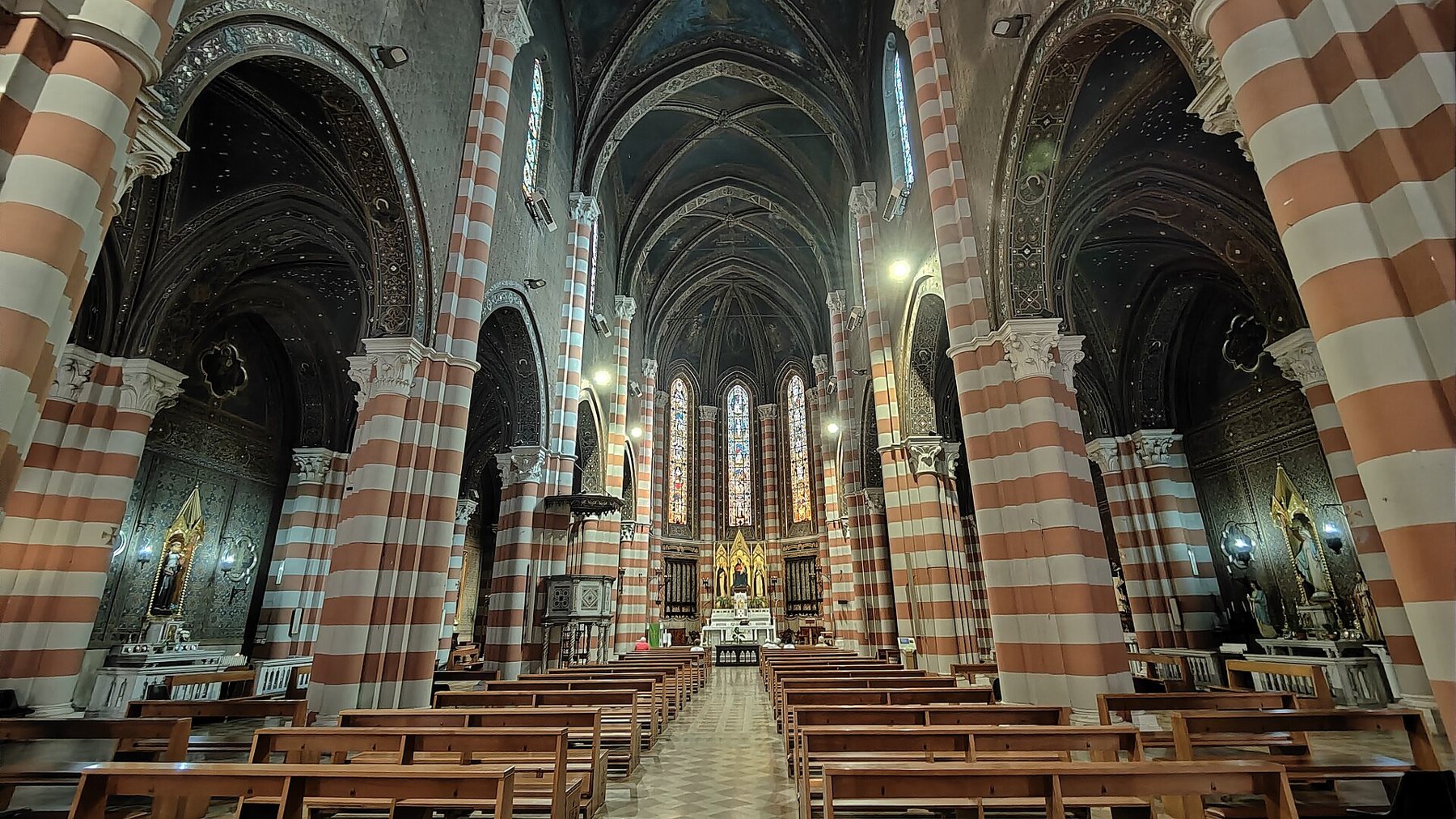
A few blocks north of Cola di Rienzo, on Via Germanico, stands Santa Maria del Rosario in Prati, a neo-Gothic church with columns striped in pink and white and a dark vault painted with stars. After the gold and marble of St Peter's it feels almost northern, like a parish church in Lombardy that has wandered south. Step in, let your eyes adjust and look down the nave to the stained glass behind the altar.
16:00Another hourCastel Sant'Angelo, from tomb to terraceThe other church worth a detour sits on the riverbank. Sacro Cuore del Suffragio, on Lungotevere Prati, is a spiky white Gothic Revival building that Romans sometimes call the little Milan cathedral. It is usually open at this hour for prayer; keep your voice down and your camera in your bag if people are at prayer, and cover your shoulders, as you would in any church in the city.
You do not need a name to eat well here; you need to know what to look for.
Piazza Cavour and the Palazzaccio
From Cola di Rienzo, turn south down Via Crescenzio or any parallel street and you come out in Piazza Cavour, the formal heart of the quarter. It is a big rectangular garden square of palms and lawns, with a monument in the middle to Camillo Benso di Cavour, the statesman who did more than anyone to make a united Italy and who died before Rome joined it. Office workers eat sandwiches on the benches here at lunch, and it is a good place to do the same.
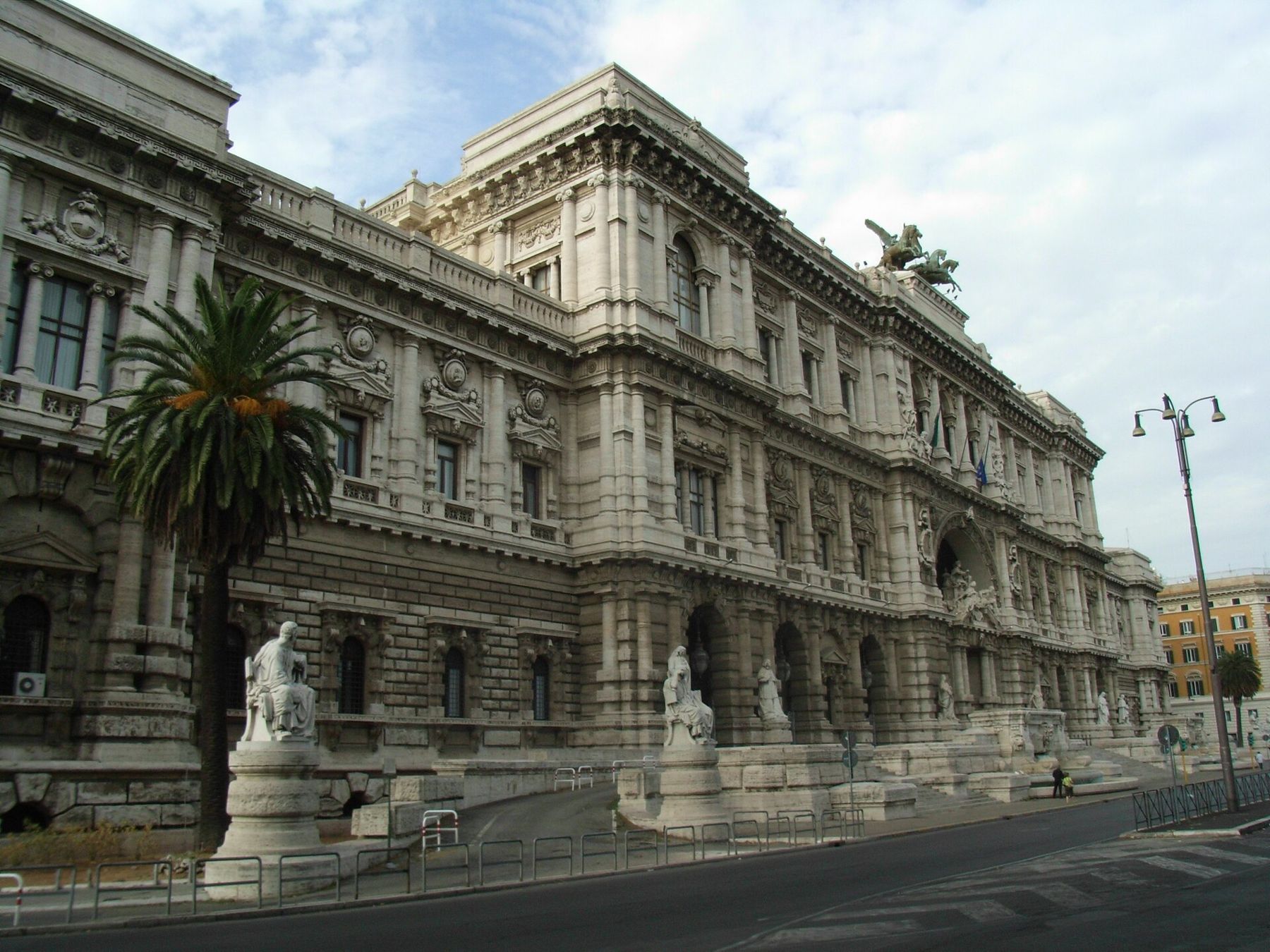
Then look south. The whole side of the square is filled by the back of the Palace of Justice, the seat of Italy's highest court, built between 1889 and 1911 to designs by Guglielmo Calderini. It is enormous, covered in travertine and sculpture, and crowned with a bronze chariot. Romans call it the Palazzaccio, the ugly great palace, partly for its size and partly for its long and expensive construction. It is hard not to admire it anyway.
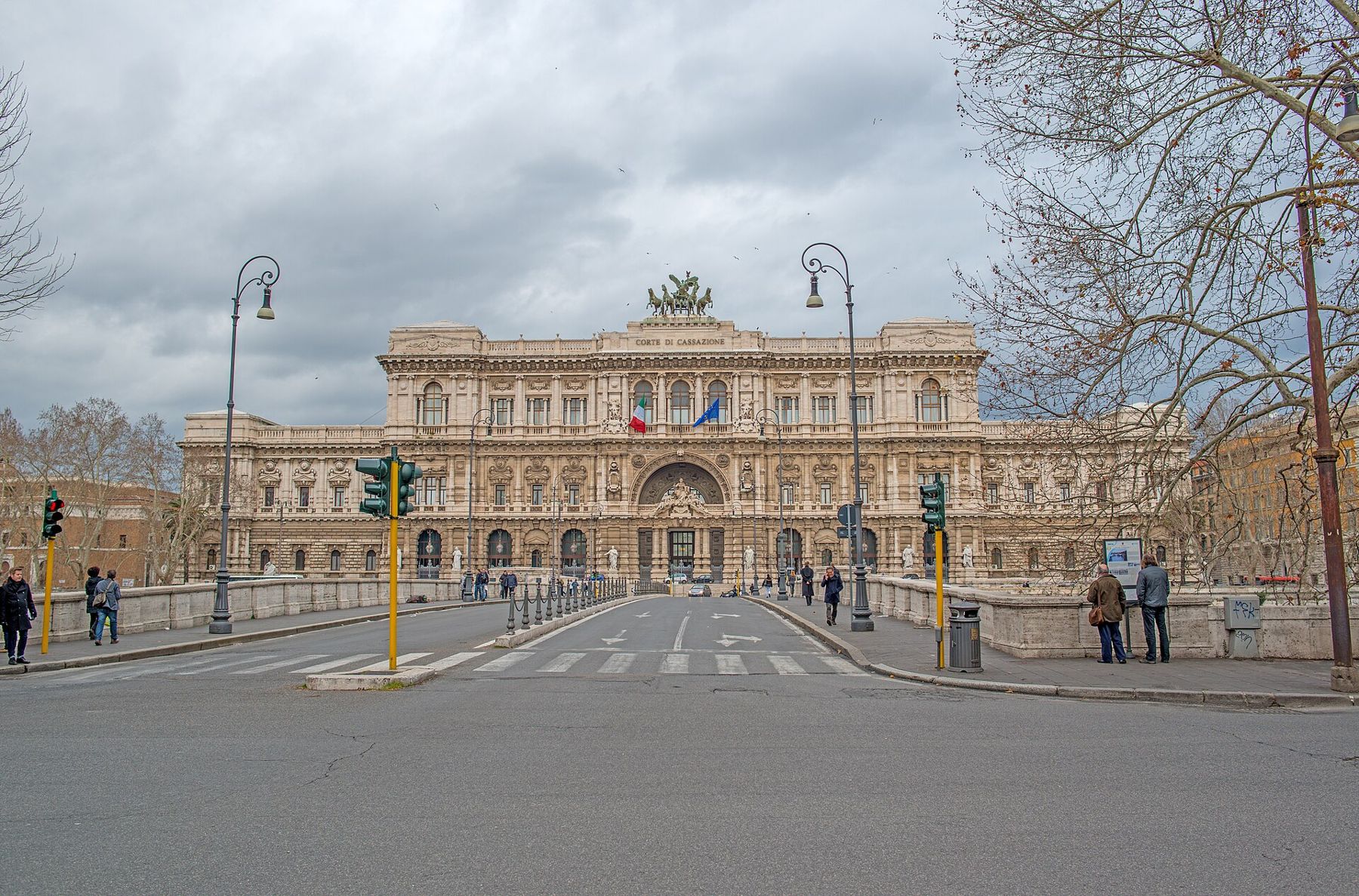
Walk round to the river front. The best view is from Ponte Umberto, the bridge that crosses the Tiber in front of the main facade; from the middle of the bridge you see the whole palace square on, with the words of the court along the top. From here the dome of St Peter's shows over the rooftops to the west, and Castel Sant'Angelo is a short walk west along the river.
Ending on the river
The statues ranged along the Palace of Justice are of famous jurists, ancient and modern, seated in heavy robes and looking unimpressed by the traffic. Walk past them west along the Lungotevere and the plane trees give you shade all the way to the castle. If you are carrying on, this is the natural link between lunch and an afternoon at the papal fortress by the river, and from there the bridge of angels is directly in front of you.
If you started the day at the Museums and are flagging, there is no shame in an early return to wherever you are sleeping. The afternoon heat from June to September makes Prati a place for walking at noon and resting at three. On a cooler day, though, it is worth keeping the afternoon open: the Borgo lies just south, and the old streets under the papal wall are fifteen minutes away on foot.
Prati also has the closest covered market to the Vatican. If you are here earlier in the day, the market on Via Andrea Doria is a better place than any counter to buy fruit and cheese for a picnic later on the river.
The photographs on this walk are credited by name and licence in I fotografi. The other walks are on the list of hours.
Later the same day
- The Borgo and the wall the popes ran along
- Castel Sant'Angelo, from tomb to terrace
- Down the Lungara into Trastevere for the mosaics
- Up the Gianicolo for the last light
- Ponte Sant'Angelo after dark
- Dress, days and bags: the rules of a Vatican morning
- Getting to the Vatican side: metro, tram and on foot
- St Peter's while the square is still empty
- Across the river: the Aventine keyhole at opening time